Sunday, January 25, 2015

The Road to the Mine, and back

Every son, to some extent, is the son of a preacher.

I have been reading a book called "Gilead," about  a multi-generational family of preachers in American Civil War times and this popped into my head this morning, eyes closed still ,after I woke up.  Maybe it is because I have been thinking about my parents a lot lately.  It is their wedding anniversary today.  Or perhaps it has to do with all the kids I have seen lose both parents to Ebola.  Of course, family structure as it is here, the children will be raised by aunts, uncles, sisters,brothers, cousins and so on who live in the same village.  Every parent is haunted by the thought of leaving their children behind or their children leaving this world before they do.

Some kids are born into families with little wilderness.  Everything is provided.  And controlled.  Others are born into great wilderness.  Parents are not involved for whatever reason from the start.  Or part way through go missing.   Or disappear during the crucial years.  And then there are children who are born with the wilderness in them.  I know how my parents would comment if posed this question.  Tonight, I think of Kadiatu, who lost both her parents here with us to Ebola, and was placed in the Children Fund's temporary orphanage after testing negative to be watched the requisite 21 days to make sure she doesn't start showing signs of Ebola.  She will go back to her village but has little family.  I wonder how the wilderness quotient will play out for her.

I went for a run this morning on the road to the iron ore mine.  It is a hard-packed red clay dirt road with occasional ribbed areas that are less than affectionately referred to as "washboards."  The road is wide enough for two articulated dump trucks to pass easily.  Iron ore is used to make pig iron and ultimately steel.  It is arguably the world economy's second biggest player behind oil.  Sadly, the mining company is owned by a Swedish firm.   Lunsar, as a community, shows no overt signs of benefiting from this precious mineral harvest.  At the end of the road there are box cars that are loaded up to be taken by rail for processing and then exportation to China I am told.  The mine operates 24/7 and I can hear the lorries wheezing and rattling from my room as I lay in bed reading.  I picked up a piece of rock that had an argent glaze on it that rubbed off into my hands like the glitter my daughter dusts onto glue to "spice up" her pictures.  It looked pre-historic like it had been taken out of a formation that had been made by a drastic event that shook the earth to its core and was not  witnessed by any higher functioning creatures besides bees.  I stuck it in my pocket for my son and kept running.  Up ahead I saw a man walking in his Sunday clothes carrying a machete in the way that a man in Detroit might carry an umbrella, tucked under his arm but still able to strut.  A lorry downshifted to make it up a hill and coughed up a cloud of exhaust that drifted like a black veil off the road and was suspended briefly in the early morning air before diffusing.  Banana tree leafs drooped with a thin, red dust that took away their waxy lustre.  The industrial effluvium reminded me of running in medical school on the banks of the Kaw River in Kansas City, Kansas behind the Colgate-Palmolive factory.  There was a sweet, synthetic scent to the air then.  We called it the "Industrial Run."  I suppose this one here on the road to the Sierra Leonean iron ore pit would qualify as an industrial run, the soot and the particulate dust sticking to my skin as if I were a lollipop dropped on a wood shop floor.  But when the trucks all passed and the morning sun poured through the palm trees and the birds cawed from high up on ancient mango tree branches, I inhaled the landscape as a whole and it filled me with power and light and a transient equanimity that made who I was or where I was blissfully irrelevant.

Our psycho-social team often goes out to provide support to families who have lost loved ones to Ebola.  Anna, an Australian, has spent the past four years working in South Sudan and Bangladesh in international relief work camps.  She is quiet and has a sadness about her that is more than situational, almost a settled, habitual sadness.  She flowers when she is working with families in that way that some people are better suited to weep with those who are suffering as opposed to those who are better suited to rejoice with those who are rejoicing.  Today, I rode out with her to a village where an 18 year old girl, Hawa, contracted Ebola before being sent to our treatment center.  You may recall her from an earlier entry.  She was 24 weeks pregnant and believed up until her last breath that her baby was still kicking.  I met her husband and all of her immediate and extended family from behind a small plastic green rope that was tied between the trees that surrounded their house in the village.  To keep them as effectively as the wind, under quarantine.  We talked about her death, expressed our sorrow and delivered the bereavement package donated by the World Food Programme which consists of 50 kilos of rice, a large sack of what looked like lentils,  a sack of  enriched corn meal, cooking oil, and some laundry soap.  I brought along some crayons, pens and pencils for the kids.  We reminded them to guard the death certificate that certifies that Hawa passed from Ebola as it will entitle them to certain small governmental benefits down the road.  I watched the kids watch me as I watched them.  They all came out of the house and stood quietly in flip-flops.  Mothers in tank- tops hipped babies.  Charred aluminum pots cooked cassava leaves  and fish stew over open flame branches.   We had come to talk about an eighteen year old pregnant woman's death and have some sense of dignified closure.  When we finished we sprayed our boots with chlorinated water before getting back into our vehicle.  We are so close but we are not out of the wilderness yet.


Saturday, January 24, 2015

For 3rd Graders Only

My daughter asked me to write a note for her that she could read to her 3rd grade class, so here goes...

Dear Jasmin and Ms. Griffin's 3rd grade class-
Hello from a country in West Africa called Sierra Leone!  I had to take 3 airplanes and make 5 stops to get here.

We are 8 hours ahead of you.  So if it is 12 noon in San Anselmo then it is 8 pm here.   I get to see the sun rise and set before you do!  We see the same moon and same stars too, but the stars are a little different.  There are over 6 million people in the entire country here.  That is like taking the population of San Francisco and multiplying it by 7.  So it is not a very big country.

Everybody in Sierra Leone speaks a language called Krio, which sometimes sounds like English but most of the time does not.  When I meet someone I will say "Aw yu du?" which means "How are you?"  But there are a lot of other languages people speak here.  It depends on where they were born and raised.  We are living in a town called Lunsar and the people here talk Temne.  When I meet someone who speaks Temne I say "Topeh moi?" which means "How are you?".  Or I say "Endiray" which means "good morning."  The languages sound a bit funny at first until you hear them a bunch.  Then they start to sound like music and are beautiful.  Jasmin, you already know one word in Temne- "Momo," which is the name of your friend in Portland, Oregon.  It means "thank you" in Temne.  Isn't that cool? I bet Momo doesn't even know that!!!

The people here are so nice.  They teach me a bunch of things every day about their way of life.  I have made a lot of friends.  Sometimes you don't even need to speak the same language to talk!!  The children here have not been able to go to school for almost 9 months now.  That would be like all of you missing an entire year of school!  Sounds fun at first, but the kids really want to go back to school.  They listen to a teacher on the radio when they can so they don't forget how to spell or do math.  All of the schools were shut down because of a really bad virus that can make people sick.  You can get the virus, called Ebola, even by just touching someone who is sick.  Can you imagine not being able to touch anyone for almost a year????

Me and a nurse called Mbalu

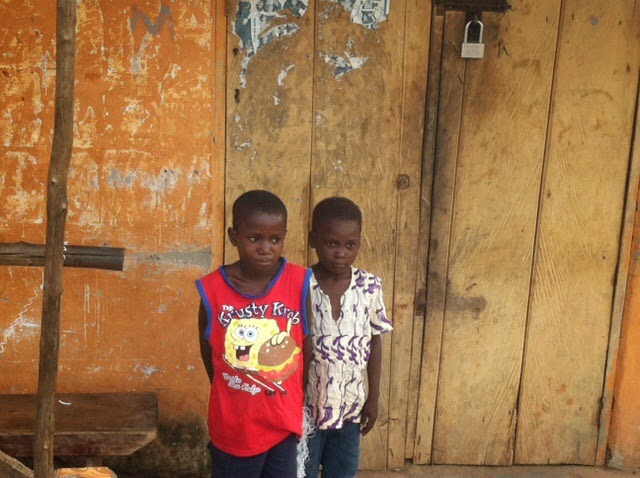
Two boys in front of their house

Me and another doctor with a nurse and her family

Every market here is a farmer's market


People here eat a lot of rice and fish.  They also make chicken, yams, corn, plantains, egg sandwiches, and lots of other stuff like stews and greens (kind of like spinach).  They drink juice and soda but mostly water.  Most of the food is cooked outside on a fire.  Like how we do when we go camping.  People make their own houses in the village out of mud bricks and cut down trees.  They are really good at it.  It is always hot here so they don't need a heater.  They like to sing and dance and have parties just like we do.  People everywhere want love and happiness.  We may have different stuff or talk different languages but we are all pretty much the same.  You would like the kids here.  They are creative and make up a lot of games and run a lot.  They make a lot of their own toys out of sticks and recycled stuff like cans.

There are a lot of animals here.  I see dogs and cats just about every day. There are goats, sheep, and chickens but not a lot of cows.  I haven't seen any horses.  They have chimpanzees and gorillas too but this virus has been getting them sick.  We hope that this virus is finished soon because it has been a terrible thing for the country of Sierra Leone and other countries in Africa.  Your daddy takes care of people sick with the virus.  I have to wear a special suit that looks like a space suit so the virus can't get me.  I am really safe here.  But it is important to come to places like this to help people.  It is like helping friends or brothers or sisters who are sick or sad.  We live in one world and everyone is our sister or our brother.  The more we help one another, the better the world will be.

Taking off the suit we wear
My laundry drying where I stay

Shakira

I think you are old enough now to come with me next time to Africa Jasmin.  Anyone else in your class ready to travel to Africa????  Awa-woo! (Good Bye in Temne)
The Beach
Palm Tree Sunset

Friday, January 23, 2015

A Day Off Poem

A pressed hospital gown
hangs
in
the closet
like a thin white ghost.

The generator
convulses
on its concrete
platform
one final time,
goes silent.

You learn after a while
to keep the shades
drawn
and not open up
the refrigerator.
To keep it all from escaping,
Or breaking in.

Days off
are like uncapped syringes
on the confirmed ward floor.

Outside the Kenyan nurse's
room
a man takes a machete
to the ochre chaparral.
It crinkles
then slouches.
No different in death than life.
For now anyway.

It could have been different.
It could have been seared,
leaving ashen stalks
on red earth,
the memory
of black plumes
rising
from the funeral pyres
that once incinerated
the virus
and all the cloistered dreams
from amygdala
to spleen
in a pit lined with stones
too large to be called gravel.

The smell of singed hair
is back to the smell of molten plastic.
The sun turns a pallid eye,
and has been confused for a hot moon.

Acronyms form and then scatter
in what few night clouds remain
in neither holy nor unholy trinities-

WHO.
NGO.
IMC.
CDC.
APB.
IMF.
CNN.
NFL.
MLK.
DNA.
PCR.
CPR.

And
RIP
written
in
dry
erase
red
on
our
whiteboard
in
the
white
medical
tent
next
to
a
name
given
three
years
ago


Thursday, January 22, 2015

Routine Water

Much gets routinized here.  In the month I have been here in Lunsar, I wake up around 5:30 as the roosters just over the fence outside my window give their throaty serenade to the sun gods.  Contrary to my normal waking reflex, I am able to be awake here for several seconds, or sometimes longer,  before making the conscious decision to open my eyes.  It is like deciding when to press the "record" button.  I have come to enjoy this form of waking and don't attempt to control what I think about there in my bed, in the dark, with my eyes closed.  I often have the images of my children conjoined with the images of the children I have met and cared for here.  I take quick survey of my body- no fever, no headache, no joint aches.  Relief.  It is with gratitude that I slowly open my eyes, put on my glasses, and reach for the day.

I brush my teeth with bottled water, cup and splash tap water onto my bearding face, wash my hands and put in my contacts, left always before right.  I gather my black shorts and KC Royals t-shirt from the balustrade of my front patio, put them on, lace up my old sneakers and stretch.  I grab a small flashlight my colleague from Sebastopol, Mary, gave me and enter the morning darkness that is just being infiltrated by the slow blush of the morning sun.  And I run.  In a zagging loop around the perimeter of our lodging compound.  Past the garden Thomas has put in since I have been here.  The rows of squash with their core yellow bugles announcing the largesse to come.  Past the heaping rows of soya beans.  Past the stalky teenage growth of pepper plants.  I used to throw the flashlight over all of them to see if the goats got into them overnight.  Now, with the goats gone, I illumine them to mark their growth and the passage of time.  A few days ago Thomas showed me the well they dug in the middle of the field.  A man stood at the bottom of a 30 foot reinforced well filling buckets of moist soil.  Two men at the top used a pulley to hoist up bucket after bucket.  All done by hand down to the water table to bring water in the dry season up to the fields.  Later in the morning a farmer walks with a watering can up and down every row like a priest carrying an aspergillum to sprinkle holy water on his congregation.

I continue my run past the generator shed that rumbles and hums.  I pass the garbage pile and the magpies fly off.  I cross the wooden plank across the dry ditch and start another lap.  Sometimes if the  guards at the gate are awake, I leave the compound and run on the iron ore lorry route next to a large rice paddy field.  But not all that often.  I don't mind running in circles, really.  I process what I am doing here by speeding up my heart rate, pulling it into my lungs, locomote, and pour it out in sweat and exhalation.  Take it in, strip it down, and be sure to let it out.  Time after time.  Near the end of my run I turn off the flashlight.  The sky fills with a soft, iridescent  light that starts at the periphery of the horizon.  And without knowing exactly when, the night has been relieved by the understated dawn.

I take off my running gear and hang them back on the balustrade in the same place I removed them from earlier.  Sweat.  Cold water swallowing.  Morning ablutions.  Continued sweat.  And when the post shower sweat has slowed and my body has cooled, I get dressed and head down for hot Nescafe and white bread with butter and bananas for breakfast.  Every day.  Routine.  Blessed routine.

I was on track this morning to start the day like every preceding day since I have been here.  I woke, kept my eyes closed, and didn't hear the roosters.  I kept my eyes closed.  And then I heard the wind pick up velocity and write about it in the trees.  Leaves shook, trees leaned.  And then leaned back. I imagined.  I opened my eyes, got up, and went to  the door.  Ink black.  Rustling of leaves and the sense of movement in the dark.  The world in dark is a foreign world of sensation.  Not having to work today until the afternoon, I slept in.  So the light came sooner than usual.  I went through my routine and laced up my sneakers.  As I stepped outside, Sharkira was not there to greet me.  The air smelled of suspended moisture and mineral dampness.  Something outside of the morning routine was being plotted.  I began my run and before I even reached Thomas's vegetable fields, the rain began to fall.  Drop after warm drop it fell onto the ground in front of me.  And onto me.  RAIN!!! In the middle of dry season, an unexpected early morning rain.  The red, dusty road was tempered and lay now like a sheet of old red velvet cake.  Rivulets of pink and brown ran downhill like a mixture of pink and chocolate milk.  The rain came down in individual drops and never coalesced into sheets.  It fell straight down and didn't slant.  Nobody else was outside as I ran and ran under it.  In it.  With it.  I thought of Father Garcia Viejo and the unopened missalettes in the darkened pews of San Juan de Dios.  I thought of how kindness and faith can dilute even the most evil of assailants.  Routines are routines and meant to be broken.  For the sake of new, better routines.  The squash bugle flowers filled with water, lap after lap.  Soon the bees would come to drink from them, yellow on yellow.  The whole earth was being baptized anew.  For the first time, I knew Ebola was truly receding. And a new routine written in water awaits me.


Wednesday, January 21, 2015

San Juan de Dios

In September, 2014, four months into the Ebola crisis here in Sierra Leone, Dr. Manuel Garcia Viejo, a Spanish priest and physician at San Juan de Dios hospital in Lunsar said his morning prayers with his staff in the small concrete church on the hospital grounds, took a cup of tea and assumed his customary role seeing patients in the busy outpatient department.  The missionary hospital was started in the early 1960's as a midwifery ward  by a Spanish nun who died from burn wounds suffered after an accidental gas stove immolation.  The Spanish Catholic priests who came to Lunsar for her funeral decided to expand the operation into a full hospital, which opened in 1967.  It continued to offer more and more medical services including an operating theatre, a 100 bed inpatient hospital, a lab, x-rays, and a full maternity ward.

Dr. Garcia Viejo started working here in 2002.  The hospital built a strong reputation throughout Sierra Leone and beyond.  People would travel from Freetown and from as far away as Guinea and Liberia to receive their care here.  On this day in September, 2014 several patients who came to be evaluated had high fevers, headaches, and joint pains.  He saw them all, taking some personally into the hospital to minister to them as they unexpectedly deteriorated rapidly.  They were all young, healthy, and followed a similar, sinister path towards death.  One of the staff reportedly cautioned Dr. Garcia Viejo about the possibility that these patients could have the deadly filovirus, Ebola. "I am an old man and if I contract Ebola and die, then it is the will of God."  Within several weeks Dr. Garcia Viejo and 8 of his nursing staff died of Ebola.  The missionary hospital that attracted patients from Liberia, Guinea, and all over Sierra Leone was in essence attracting Ebola sufferers from the most affected locations on the planet.  And it wasn't prepared in the least to protect its patients or its own healthcare workers.

San Juan de Dios was shut down by the local government when word got out that staff and their families were dying en masse.  The village of Lunsar, who trusted this medical institution for over 45 years, was thrown into a complete panic.  If their hospital couldn't stop Ebola, then surely they themselves couldn't stop Ebola.  The hospital gate has been locked since September, 2014.  Until this past week when it slowly and deliberately opened its doors in the outpatient department.  My organization, IMC, was asked to help prepare for this re-opening by building a labyrinth of partitions and installing a chlorinated water system to effectively triage possible Ebola cases.  If they screen negative then they can see the Nigerian doctors who staff the hospital now until the Spaniards return. If they screen positive then they are sent to our treatment center for testing and care.  I went there today for the first time to help make sure everyone was following infection control protocols and help with the triage process.

Hawanatu and Aminata sat in a small triage room with a plastic window through which patients were screened using a series of questions to assess their risk of having come into contact with, or had symptoms of,  Ebola.  One after another, patients came to the hard plastic window complaining of vaginal bleeding, complaining of cough, complaining of neck pain.  But not one today screened positive as a suspected Ebola case.  On the concrete walls were colorful murals depicting African life.  A mother nursing her baby while she cooked a pot of greens over an open flame.  A boy in flip flops carrying his books to a one room schoolhouse, the red dirt carpet in front at the foot of a giant mango tree.  A photocopied picture of the departed Spanish priest was taped up just underneath the right bottom corner of an African version of the last supper and included the handwritten letters "RIP Brother Manuel."  I talked to Abdulai, a recent physician's assistant graduate, about the African Nations Cup games played last night.  He made flirtatious comments to Hawanatu between patients and she attempted, unsuccessfully, not to smile. Hope, and life, were now returning to San Juan de Dios.

There is a definite transition happening here now.  Institutions and establishments are starting to discuss when they will open their doors and unshutter their windows again.  Schools have not announced when they may follow suit but people are starting to think about stepping back into their lives again.  The UN choppers overhead are less frequent.  The markets have more colorful produce.  But we are still seeing new cases everyday in our district.   Smoldering coals can re-ignite.  This is the biggest public health fight Sierra Leone has ever faced and complacency and crisis fatigue are not an option.

As I finished work at San Judas de Dios hospital today, I could feel the absence of Dr. Garcia Viejo on the grounds.  The concrete fountain with a statue of a monk tending to children looked like it had been dry for years.  The grass behind the admissions foyer grew up onto the wrought iron fence.  The operating theatre table slumped like a dusty leatherette cross alone in the windowless daytime dark.  The autoclave door was ajar in the recovery room.  The doors were all closed in the hospital and the silence interrupted only by overhead birds, perched on the corrugated tin roof.  Beyond the birds I saw the solar panels tilted toward the afternoon sun, patiently waiting to be of service. A few vehicles unloaded medical supplies.  A nun behind a desk smiled as a little girl peeked into her office from between her mother's skirted legs.  Men gathered around a transistor radio placed on a tree stump to listen to a soccer match.  The smell of roasting plantains wafted through the iron gate. A resurrection was underway.


Tuesday, January 20, 2015

Dirt Road, Paved Road

At the end of the ulcerated dirt road from our hotel complex, the dirt gives way to a crested paved road.  Used blue jeans hang from a make-shift bamboo rack on the corner.  The girl I buy hard-boiled eggs from every week, Mabenty, sits under a palm leaf thatched swath of shade on the side of the street.  Mohammed flanks her, selling dense white bread rolls the size of an iphone, and carries a jar of mayonnaise that for some reason obviates the need for refrigeration.  In case you want to parlay your purchases into a fine egg sandwich.  Across the street, miners from the nearby iron ore pit dismount from a large, open air transport truck wearing hard hats and bright orange vests.  Their faces look weary from working until exhaustion deep in the earth.  The gas station behind them has Nigerian pop music blaring out from somewhere and the tin of the treble is swept away like iron dust by the magnetic whoosh of passing land rovers, motorbikes, and ambulances.  I had the day off today and was heading north to a town called Makeni.

Makeni, during the civil war that ended just over a dozen years ago, was the base for the rebel group called the revolutionary united front (RUF).  They orchestrated a reign of terror that tortured and killed fellow Sierra Leoneans over more than a decade.  It is also the hometown of the current president, Ernest Bai Koroma.  It is a 40 minute drive from our town and has a small grocery store with a restaurant on top that is well known to ex-patriates in the area.  Judging by the absence of gaping potholes, the road seems relatively new.  Mud brick and concrete houses ensheath the road on both sides with baskets of oranges, bananas, plantains, and cassava for sale in hard-packed dirt front yards..  In the distance shirtless men shape mud bricks from a small clay colored pool of shallow water and line them up to dry in the sun.  Hand-held hoes glimmer and slice in the distance as fertile fields are prepared for the rain-squalls that will come in a few months.  I thought about the civil war here and how the landscape must have looked when villagers were running through it for their lives, having left their hands behind.  I thought about a painter we knew in Nashville who wrote that "all war is civil war" as part of a show he did with paintings he made from American Civil War photographs in a studio just behind the minor league baseball stadium.  Germain, a Congolese physician colleague, snored next to me as I stared out the window, the images all fusing together until we reached an area with wide open grasslands whose emptiness was swept by the wind of forgiveness.

We went through two checkpoints where we opened our windows and leaned forward to have our temperatures checked by thermal scanners.  Our International Medical Corps emergency response pass taped to the front window allowed us to pass through the other military checkpoints with only a glare from the armed guard in fatigues who pressed truck and bush-taxi drivers for proof of tax payments in a long, slow heated grind.  The outskirts of Makeni didn't look all that different from Lunsar, despite its claim as being the 4th largest town in Sierra Leone.

Avnad's was in a small African-style strip mall with a red dirt parking lot.  We entered through the glass door and were greeted by a Sierra Leonean who took our espresso order as a Lebanese man smoked out front and talked pressingly on the phone.  Most of the major stores in Sierra Leone, our driver told us, are owned by the Lebanese.  They have been long involved in the diamond merchant business here and are reportedly often the middle-men in diamond dealings, even now that restrictions have been put in place regarding the "clean" exportation of diamonds.  I drank my espresso eagerly.  I have been drinking Nescafe since I arrived and have had a low level headache I am coming to beliefve is related to the drastic drop off in caffeine consumption since my arrival.  That and the pound of salt that precipitates on my skin daily from being in PPE.  The aisles were full of sweets imported from Lebanon, wine and liquor from France, England, and South Africa, and even a solitary bottle of el Patron tequila from Mexico.  There were snack crackers from China in long oblong packages, brightly colored soups with Arabic characters scrawled across the front and many iterations of vienna style canned sausages and spam.  I bought Sierra Leonean cheese puffs, Thai potato chips, and a small bar of soap made locally to wash my clothes.  Others in our group stuffed their basket with Pringles, Skittles, and Argentinian red wine.  After we paid we went upstairs to the Lebanese restaurant that looked out over the hills of Makeni.  It was empty and rather formal with plastic over ornate table clothes and pleated upholstered chairs.  We ate Falafel and were just content to have a different variety of food, and a new view.

The driver needed to pick up a large toaster from a similar Lebanese owned grocery store down the road.   We waited for him in the van.  The still humid air made an invisible curtain of heat.  And then the suffering.  A little girl, probably my daughter's age and half her size, using a t-shirt as a skirt, and shirtless, peered into our van with the most beautifully sad eyes and held out her hand.  An older girl, perhaps 14, pedaled up in a home-made wheel chair that had a bicycle sprocket shaft drive she could turn with her hands because her legs were shriveled up and useless.  She too, held out her hand.  Soon a procession of blind men and women, with hands on the shoulders of children whose duty it is to shepherd them around begging for alms, crowded the open sliding door to our Toyota van.  I called over to a peanut vendor and bought peanuts for everyone.  And did it again for the next wave.  We sat there for what seemed like a heart-wrenching eternity, each silently under the hot spotlight of moral interrogation. As we backed out and climbed back up onto the paved road, a group of the children were gathering around an older child who was banging a coconut on a rock.  It may as well have been my head.


Monday, January 19, 2015

Threshing Ebola

A worm the size of a pencil, the color of the pencil eraser, was on the floor next to Marie's bed yesterday.  When a person has worms compounded by a high fever they naturally want to get out.  She vomited it up.  It was a type of worm called ascaris by appearance, the so-called roundworm seen in the tropics, usually in children.  We treat it with medication and when the worms die off they often are excreted in the feces.  When the burden of worms is very high, however, they can clog up in a mound in the GI tract and cause an obstruction.  This can be an emergency and require an intervention, sometimes surgical, to be fixed.  Combine this with Ebola and you have a volatile, tropical sickness.

Today when I rounded I drew blood on patients.  Men and women offered their tough, leathery arms with tendons bulging out like fleshy violin bows.  Most of the patients did not even wince when the butterfly needle punctured the skin.  One of the babies, Kadiatu ,was very dehydrated and I couldn't find a vein plump enough from which to get blood for her Ebola test.  I had to get it out of a large vein called the femoral vein which is in the groin.  The caretaker, herself an Ebola survivor who now helps by staying with the children without the need for PPE in the ward, had to hold her hands and legs as I stuck her in the groin, careful not to go through a superficial infection she had in the region.  She cried very little and, because of her dehydration, produced no tears.  Her mother had died of Ebola in our unit a few days ago.

Marie, the woman who vomited the worm, was in attendance at a recent funeral as were two other women now in our confirmed ward.  When the dead are buried here in the village, they often use a rice paste to cleanse the body in preparation for the afterlife.  An Ebola corpse is highly contagious and continues, despite a public education campaign, to be a significant vector of new infections.  

I hung a liter of IV fluids for Marie when I saw her and, because of severe abdominal pain, gave her morphine through her IV.  People here have never had any narcotics.  I watched as I pushed in the morphine as her breathing became less labored and the wrinkles on her brow relaxed.  It didn't last long, though, and she appeared uncomfortable by the time I left the tent.  She was found dead two hours later, her pain and fear shut off at last.

It is said that for every one Ebola patient we identify there are at least 2 more who contracted Ebola from that person.  I don't know how true that is.  Frankly, I don't know how true any of the numbers the government is releasing are.  If we are to believe them, then the epidemic seems to have slowed over the past two weeks.  Our organization's focus has shifted to reflect this, at least in planning.  We are opening up several "screening and referral units"(SRU's) which will function to screen all patients entering a local medical facility for Ebola before they can be seen.  If they screen positive they will be sent to our center.  If they screen negative they can be seen by a local medical team for whatever afflicts them.  This is how the medical system is gradually going to open its doors.  Safely and deliberately.

The most extraordinary people I have met here are the national staff we work alongside.  I have gotten to know many of the nurses well and am blown away by their courage, trust, and love.  A few days ago I was out walking in the village and ran into one of the nurses, Mbalu, who was threshing her rice , separating out the rice from the husk, or chaff.  She has two children back in Freetown but came to Lunsar to take one of the few, precious jobs available in the region.  Another woman was pounding away with a giant pestle to pulverize cassava in the wooden mortar.  Children ran around kicking a tin can, laughing.  Papaya trees, no taller than me, already boasted green bosoms of fruit.  The sound of flip flops fell in a muted ricochet off the pile of tin roof sheets leaning up against the mud brick house.  There were so many village scenes in one visual field, all resonating off one another, there in the fading afternoon sun, like a stage set.   I thought of my time in the Peace Corps so long ago.  I saw the birth of my children in soft, holy light and how, eyes closed, they rooted for Sandra's nipple.  I saw my parents on their first date in New Bedford, MA at a soda fountain where my motherworked.  I thought of how at peace this moment is right here, at this very place, at this very second.  We do what we can, when we can, where we can.  And when we do, the whole universe seems to be threshed from the limiting grip of its husk and we are granted passage into the inner sanctum, where the golden mystery of all mysteries was conceived.  Only to  leave again, our steps untraceable as air.

Mbalu and Me, Lunsar